
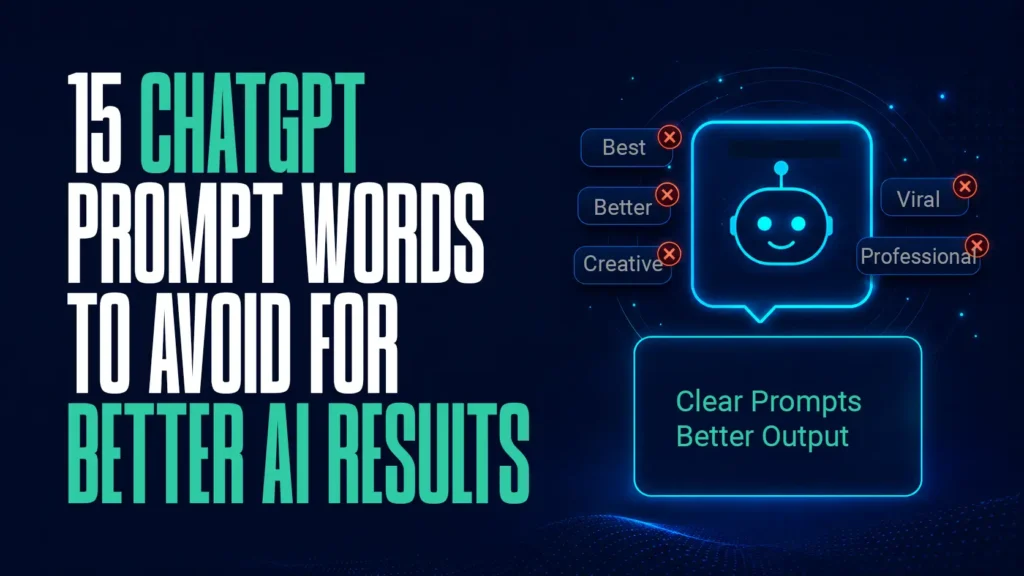
ChatGPT is powerful. But it is not a mind reader.
Most people don’t get weak AI results because ChatGPT is bad. They get weak results because their prompt is too vague.
They type one small line like, “Make it better,” “Make it creative,” or “Write the best caption.” Then they wait for a great answer.
But ChatGPT has to guess. And when AI guesses, the output becomes average. This is why learning how to write better ChatGPT prompts is important, especially for small business owners, creators, marketers, students, and freelancers.
You don’t need to become a prompt engineering expert. You just need to stop using unclear words without context.
In this article, we will look at 15 ChatGPT prompt words to avoid or use carefully. These words are not wrong. But they are incomplete.
The goal is simple. Give clearer instructions. Get better AI results.
The real problem is not the word. It is the missing meaning.
Words like best, creative, premium, viral, and professional sound strong. But they do not tell ChatGPT what you really want.
For example, when you say, “Make it creative,” what does creative mean?
Funny? Emotional? Bold? Premium? Simple? Dramatic? Sales-focused?
For a restaurant, creative may mean mouth-watering and fun. For a real estate brand, creative may mean premium and trust-building. For a coach, creative may mean warm and inspiring.
Same word. Different meaning. That is why your prompt needs direction. A weak prompt gives a feeling. A better prompt gives a clear instruction.
Weak prompt:
“Make it better.”
Better prompt:
“Make it shorter, clearer, sharper, and easier for small business owners to understand.”
See the difference?
The first one makes ChatGPT guess.
The second one tells ChatGPT what to improve.
1. Words that sound strong but are too vague
Let’s start with the words people use most often: best, better, creative, professional, and premium.
These words sound useful. But without context, they create confusion.
When you say, “Create the best carousel,” ChatGPT does not know what best means.
- Best for whom?
- Best for Instagram or LinkedIn?
- Best for awareness or sales?
- Best for a beginner or expert?
A better ChatGPT prompt would be:
“Create a carousel for small business owners. The goal is to explain why clear social media content brings more leads. Keep the tone simple, direct, and sales-focused. Each slide should have less than 12 words.”
Now the prompt has audience, goal, tone, and format.
The same issue happens with “better.” “Make it better” is one of the weakest prompts because better can mean anything. Shorter. Longer. Emotional. Premium. Funny. Direct. Sales-focused.
A better prompt is:
“Make it shorter, sharper, more premium, and easier for a small business owner to understand.”
Now ChatGPT knows what kind of better you want.
“Creative” also needs direction. If you say, “Make it creative,” the answer can go anywhere. It may become too funny, too dramatic, too fancy, or too random.
A better prompt is:
“Make it unexpected but still easy to understand. Avoid fancy English. Use a strong hook and one simple emotional insight.”
This gives the creativity a boundary.
“Professional” is another tricky word. A lawyer, doctor, designer, restaurant owner, and startup founder will not sound professional in the same way.
Instead of saying, “Make it professional,” say:
“Make it sound like a serious agency proposal. Keep it confident, clean, and not too casual. Avoid hype.”
That is much clearer.
Then comes “premium.”
Many people think premium means fancy words. That is wrong. Premium usually means fewer words, more confidence, and less noise.
Instead of saying, “Make it premium,” say:
“Make it feel premium. Use fewer words, more confidence, no discount-heavy language, refined tone, and clean structure.”
Premium does not shout. Premium speaks with control.
2. Words that chase performance without giving a plan
The next group is very common in content creation: viral, unique, detailed, simple, and catchy. These words are not bad. But they need control.
Let’s take “viral.”
A lot of people ask ChatGPT, “Make this viral.” But no one can guarantee viral. Not ChatGPT. Not an agency. Not even a big creator.
Viral depends on timing, audience, platform, emotion, trend, and sometimes luck. But you can improve the chance of better performance.
So instead of saying, “Make this viral,” say:
“Give me 5 hooks that can stop scrolling in the first 2 seconds. Make them curiosity-based, simple, and useful for Instagram Reels.”
This prompt is smarter because it asks for something practical. You are not asking for magic. You are asking for better hooks.
Now look at “unique.”
“Give me unique ideas” sounds good, but it can create weird ideas. And a business does not need weird ideas. It needs relevant ideas.
A better prompt is:
“Give me ideas that small Indian businesses are not commonly using. Avoid generic tips like post consistently or use hashtags.”
Now the word unique has a direction.
“Detailed” also needs control.
If you simply say, “Make it detailed,” ChatGPT may give you a long answer that needs too much scrolling. More words do not always mean more value.
A better prompt is:
“Explain it in detail, but keep the language simple. Use examples for restaurants, salons, clinics, and coaches.”
This tells ChatGPT to be useful, not just lengthy.
The word “simple” also looks clear, but it is not always clear.
Simple for whom? Simple for a digital marketer is different from simple for a shop owner.
So instead of saying, “Make it simple,” say:
“Make it understandable for a shop owner who has never used digital marketing terms.”
That is a much better instruction.
Then there is “catchy.” “Write a catchy caption” often produces cheap lines, too many emojis, or fake excitement.
A better prompt is:
“Write a caption with a strong first line, simple body, soft selling, and a CTA to DM for AI content service.”
That prompt gives structure.
A good caption is not just catchy. It should attract attention, explain the point, create interest, and guide the reader to act.
3. Words that need more context
Now let’s talk about the third group: luxury, modern, high-quality, optimize, and human-like. These words are useful, but only when you explain what you mean.
Start with “luxury.”
If you say, “Make it luxury,” ChatGPT may use heavy and over-the-top lines. But luxury is usually calm. It is refined. It does not scream.
A better prompt is:
“Make it calm, refined, and aspirational. Avoid loud selling, emojis, and offer-heavy wor ds.”
This tells ChatGPT the mood.
For example, “Buy now and enjoy the most luxurious lifestyle” sounds loud.
But “A quieter way to live closer to nature” feels more premium. That is the difference.
Now take “modern.” “Make the design modern” is too broad. Modern can mean minimal, bold, tech-style, corporate, youthful, luxury, or experimental.
So instead of saying that, say:
“Use a clean layout, bold headline, lots of breathing space, minimal colors, and no clutter.”
Now ChatGPT understands the design behavior.
The same goes for “high-quality.” “Give me high-quality content” is not a proper instruction. High quality is the result you want, not the process.
A better prompt is:
“Give me content that has a strong hook, clear problem, practical solution, emotional reason, and direct CTA.”
Now you are giving ChatGPT the ingredients of quality.
“Optimize” is another word people use casually. “Optimize this” is incomplete. Optimize for what?
SEO? Engagement? Conversion? Readability? Sales? DM inquiries? Carousel saves?
A better ChatGPT prompt is:
“Optimize this caption for Instagram engagement. Make the hook stronger, reduce length, and add a comment-based CTA.”
Now there is a clear goal.
Finally, “human-like.” This is a popular prompt, but it is still vague. What kind of human-like?
A friendly teacher? A senior copywriter? A founder? A business coach? A digital marketer? A storyteller?
A better prompt is:
“Make it sound like an experienced marketer talking directly to a small business owner. Keep it simple, honest, slightly conversational, and not robotic.”
Now ChatGPT has a voice.
Human-like writing is not about adding casual words. It is about sounding clear, natural, and useful.
The better ChatGPT prompt formula
Here is a simple formula you can use for better ChatGPT prompts:
Goal + Audience + Format + Tone + Limit + Example
Your earlier draft used the same core formula: goal, audience, format, tone, constraint, and example.
Let’s understand it in a simple way. Goal means what you want to achieve. Audience means who the content is for. Format means what you want ChatGPT to create. Tone means how it should sound. Limit means what boundaries it should follow. Example means any reference style you want.
Here is a strong prompt:
“Create a 7-slide Instagram carousel for small business owners who struggle with inconsistent social media posts. The goal is to sell my AI Content Starter Pack. Tone should be simple, direct, and slightly emotional. Each slide should have less than 12 words. Avoid jargon. End with a DM CTA.”
This prompt works because it does not leave everything open. ChatGPT knows the audience, the format, the goal, the tone, the limit, and the CTA.
That is why the output becomes stronger.
Before you write your next prompt
Here is the simple rule.
Don’t say:
“Make it better.”
Say:
“Make it clearer, shorter, sharper, and more useful for my audience.”
Don’t say:
“Make it creative.”
Say:
“Make it unexpected but still easy to understand.”
Don’t say:
“Make it professional.”
Say:
“Make it confident, clean, serious, and not too casual.”
Small changes in your prompt can create a big change in the result. Because ChatGPT works better when your instruction is better.
Final thoughts: 15 ChatGPT Prompt Words to Avoid
ChatGPT is not just a tool.
It is more like a creative assistant. But even the best assistant needs a proper brief. If your prompt is vague, the answer will also feel vague. If your prompt is clear, the answer becomes useful.
So next time, don’t depend on words like best, better, creative, premium, viral, or professional without explaining them.
Give context. Mention your audience. Define the tone. Set limits. Share examples.
That is how you write better ChatGPT prompts.
Better prompt in.
Better AI result out.