
Most local restaurants already have the most powerful marketing asset in their hands.
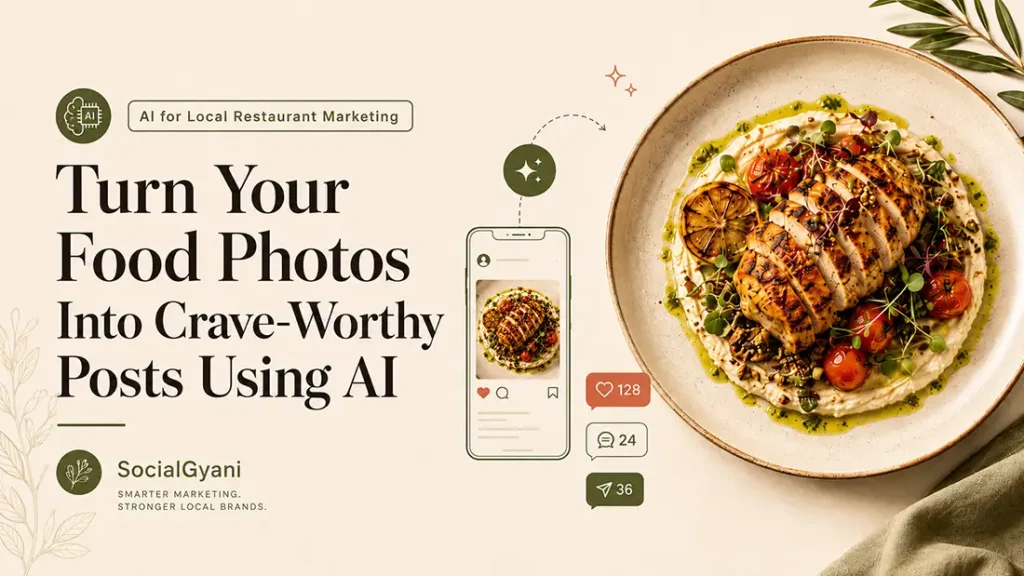
Their food.
A hot plate of biryani. A cheesy pizza pull. Fresh momos. Crispy samosas. A beautiful thali. A dessert that can stop the scroll.
But here is the problem.
Many restaurants post food photos, but very few turn those photos into content that creates cravings.
A food photo alone is not enough anymore. People scroll fast. Every restaurant is posting “Try our special dish” or “Visit us today.” After some time, everything starts looking the same.
This is where AI can help.
AI for local restaurant marketing is not about replacing creativity. It is about helping restaurant owners, café owners, cloud kitchens, and social media managers create better content ideas faster.
With the right prompts, AI can help you create hooks, captions, reels, offers, story ideas, local posts, and even a complete monthly content calendar.
Your food brings the taste.
AI helps you find the angle.
Why Restaurant Posts Need More Than Food Photos
Food photos are important. No doubt.
If the food does not look good, people may not stop. But if the idea behind the post is weak, even a beautiful photo may not get attention.
Think about these two captions.
“Try our delicious biryani today.”
Now compare it with this:
“POV: You said you’ll eat light, but the biryani had other plans.”
The second one feels more human. It has humour. It has a small story. It makes people smile. It also gives them a reason to tag a friend.
That is the difference between a normal food post and a crave-worthy restaurant post. The goal is not just to show food.
The goal is to make people hungry before they visit.
AI Can Help You Find Better Content Angles
Most people use AI in a very basic way.
They ask:
“Write a caption for my restaurant.”
Then they get a boring caption. The problem is not AI. The problem is the prompt. Instead of asking AI only for captions, ask it for content angles.
- A content angle is the main idea behind the post. It tells you how to present the food in a way that people care about.
- A samosa can become a rainy-day craving post.
- A pizza can become a funny friend-tagging post.
- A thali can become a family lunch memory.
- A coffee can become a Monday survival post.
- A dessert can become a cheat-day confession.
Same product. Different emotion. Better content.
This is where AI becomes powerful for restaurants. It helps you see one dish from many creative angles.
Your Food Is The Product. The Feeling Is The Content.
Restaurants often talk only about the food.
But people share feelings.
They share nostalgia. They share cravings. They share humour. They share local pride. They share posts that remind them of their friends, family, college days, office lunch, or weekend plans.
A good restaurant post should answer one simple question:
“What feeling does this dish create?”
- Does it feel like comfort?
- Does it feel like celebration?
- Does it feel like a rainy evening?
- Does it feel like a family Sunday?
- Does it feel like a cheat meal?
- Does it feel like a late-night craving?
Once you know the feeling, AI can help you turn it into a post.
For example, instead of writing:
“Hot pakoras available today.”
You can write:
“Some rainy days don’t need plans. Just chai, pakoras, and one good conversation.”
That line sells a moment.
Not just food.
Turn One Dish Into Many Posts
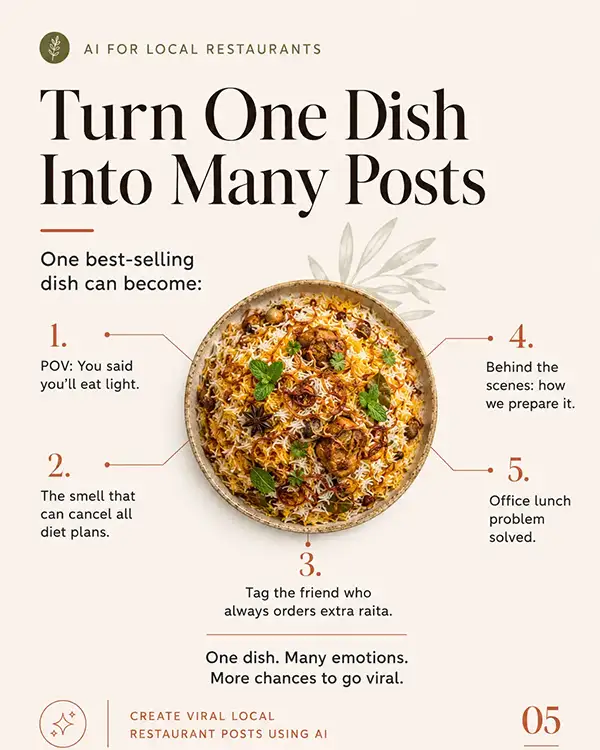
A lot of restaurant owners think they need new photos every day. Not always. One dish can become many different posts if you use the right content angles.
Let’s take biryani as an example.
You can create a craving post:
“The smell that can cancel all diet plans.”
You can create a funny post:
“Tag the friend who always orders extra raita.”
You can create a reel:
“Watch how we prepare our dum biryani.”
You can create a poll:
“Extra masala or extra raita?”
You can create a local post:
“Sunday in [city] without biryani feels incomplete.”
You can create an offer post:
“Your weekend lunch plan is ready.”
This is smart content marketing. You are not creating random posts. You are building different stories around the same dish. AI can help you do this in minutes.
Use AI To Create Local Hooks
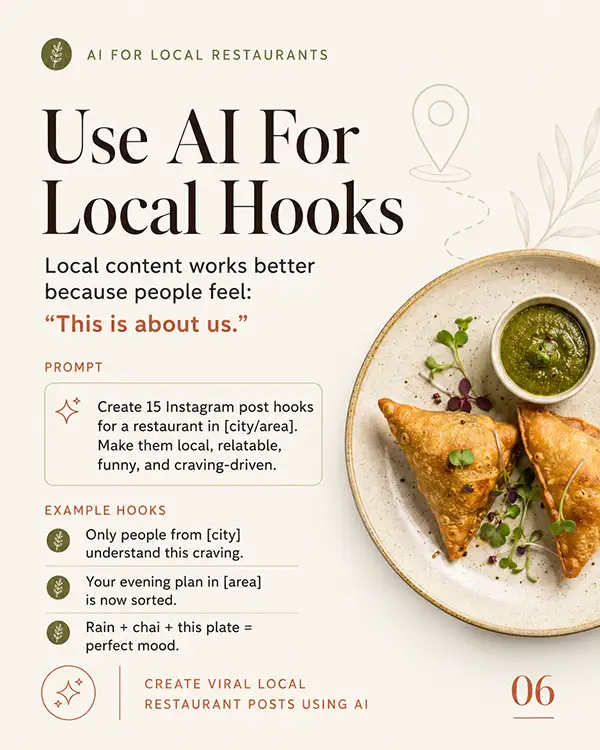
Local restaurants should not sound like big national brands all the time. They should sound local. That is their advantage.
A small restaurant in Pune, Mumbai, Delhi, Jaipur, Lucknow, Indore, Hyderabad, or any other city can create content around local culture, local weather, local habits, local office crowds, local college life, and local food moods.
People stop when a post feels like it is speaking to them.
Instead of: “Visit us for evening snacks.”
Say: “Your evening plan in [area] is sorted.”
Instead of: “Try our chai and snacks.”
Say: “Rain + chai + this plate = perfect mood.”
Instead of: “Best momos in town.”
Say: “Tag the friend who can never say no to momos.”
AI can help you create these hooks quickly. But you must give it proper context. Tell AI your city, your food type, your audience, and your restaurant vibe.
The more specific your input, the better the output.
Make Your Restaurant Posts Tag-Worthy
Food is social.
People eat with friends. They plan dinner with family. They order snacks with colleagues. They go out with partners. They tag people when something feels relatable.
That is why tag-worthy content works well for restaurants.
Here are a few examples:
- “Tag someone who always says ‘just one bite’.”
- “Send this to the friend who never pays the bill.”
- “Tag your dinner partner for this weekend.”
- “Send this to your office lunch group.”
- “Tag the person who owes you a treat.”
These posts work because they are not only about food. They are about people. And people love to see themselves in content.
AI can help you create dozens of such tag-worthy ideas for your restaurant page.
Use AI To Create Reel Scripts
Food reels are powerful because food is visual.
But many restaurant reels fail because they are just random clips with trending music. A better reel needs a simple structure.
Start with a hook. Show the food close-up. Show the making process. Show the final reveal. End with a clear call-to-action.
For example, if you are promoting a burger, your reel structure can be:
- Hook: “This burger is not for small cravings.”
- Shot 1: Bun being toasted.
- Shot 2: Sauce being spread.
- Shot 3: Patty being placed.
- Shot 4: Cheese melting.
- Shot 5: Final burger close-up.
- CTA: “Save this for your next cheat day.”
This is simple. Easy to shoot. Easy to understand. AI can create this structure for any dish.
You only need to give the dish name, restaurant type, mood, target audience, and platform.
Stop Selling Discounts. Sell Moments.
Discounts can attract attention. But if every post is about discount, the restaurant may start looking cheap. There is a better way.
Instead of saying:
“20% off on dinner.”
Say:
“Your weekend dinner plan is ready. Bring your people. We’ll handle the food.”
The second line feels warmer. It sells a moment.
People do not go to restaurants only because they are hungry. They go to spend time. They go to relax. They go to celebrate. They go to meet friends. They go to feel good.
Your restaurant posts should show that feeling. AI can help you rewrite boring offers into better, more emotional, more premium copy.
Some AI Prompts For Local Restaurant Posts
Here are some ready-to-use AI prompts you can try.
Prompt 1: Restaurant Post Angle Generator
Act as a senior social media strategist for a local restaurant.
My restaurant serves [food type] in [city/area]. Our target audience is [families / students / office crowd / couples / premium diners]. Our best-selling dishes are [dish names]. Our brand personality is [friendly / premium / fun / traditional / modern / family-focused].
Create 30 social media post angles that can help us get more engagement, saves, comments, tags, and restaurant visits.
For each idea, give me:
- Post angle
- Hook line
- Caption idea
- Suggested visual
- CTA
Focus on cravings, local culture, humour, family moments, office lunch, weekend plans, customer emotions, and behind-the-scenes content.
Avoid generic lines like “Visit us today” or “Try our delicious food.”
Prompt 2: Turn One Dish Into 15 Posts
Act as a creative director for restaurant marketing.
I want to promote this dish: [dish name].
Restaurant type: [café / family restaurant / street food outlet / fine dining / cloud kitchen / bakery]
Location: [city/area]
Audience: [target audience]
Brand tone: [funny / premium / homely / youthful / traditional / bold]
Turn this one dish into 15 different social media content ideas.
Include craving posts, funny posts, reel ideas, behind-the-scenes ideas, story poll ideas, offer ideas, and customer reaction posts.
For each idea, give:
- Hook
- Caption
- Visual direction
- CTA
Make every idea different. Do not repeat the same thought.
Prompt 3: Local Hook Generator
Act as a local culture expert and restaurant copywriter.
Create 25 scroll-stopping hooks for a restaurant in [city/area] that serves [food type].
The hooks should feel local, relatable, simple, funny, and craving-driven.
Use local moments like weather, traffic, office lunch, college friends, family dinners, weekend plans, festivals, evening snacks, and late-night cravings.
For each hook, mention:
- Hook
- Best use: Reel / static post / story / carousel
- Emotion triggered: craving / humour / nostalgia / FOMO / comfort / local pride
Avoid overused hooks like “Foodies, this is for you.”
Prompt 4: Restaurant Reel Script Generator
Act as an Instagram Reel strategist for local restaurants.
Write 10 short Reel scripts for [dish name] from [restaurant type] in [city/area].
Each Reel should be 10–15 seconds long and easy to shoot on a phone.
For each script, give:
- Hook in the first 2 seconds
- Shot-by-shot scene plan
- On-screen text
- Voiceover
- Music or sound suggestion
- CTA
- Editing style
Make the reels mouth-watering, fast, simple, and realistic for a small restaurant team.
Prompt 5: Tag-Worthy Restaurant Post Ideas
Act as a social media engagement expert.
Create 20 tag-worthy post ideas for a local restaurant that serves [food type] in [city/area].
The goal is to make people tag friends, partners, office colleagues, family members, and foodie friends.
For each idea, give:
- Hook
- Caption
- Suggested visual
- CTA
- Why people will tag someone
Make the ideas funny, relatable, and natural.
Prompt 6: Restaurant Offer Rewriter
Act as a premium restaurant copywriter.
Rewrite this offer so it feels more emotional, attractive, and premium:
Offer: [insert offer]
Restaurant type: [restaurant type]
Audience: [target audience]
Location: [city/area]
Brand tone: [premium / friendly / family-focused / youthful / traditional]
Give me 10 better versions.
Each version should avoid sounding cheap. It should sell the moment, not only the discount.
For each version, give:
- Headline
- Caption
- CTA
- Suggested visual
How Restaurants Can Use AI Every Week
AI can become a weekly content assistant for any restaurant.
- Every Monday, you can ask AI to create post ideas for the week.
- Every Tuesday, you can create reel scripts.
- Every Wednesday, you can create story polls.
- Every Thursday, you can rewrite offers.
- Every Friday, you can create weekend content.
- Every festival, you can create special campaign ideas.
This saves time. But more importantly, it brings structure.
Instead of posting randomly, you start posting with a clear purpose.
- One post can create craving.
- One post can bring comments.
- One post can make people tag friends.
- One post can push a weekend visit.
- One post can promote a dish.
- One post can build brand memory.
That is how restaurant content becomes stronger.
Final Thought
Your restaurant does not need more random food posts.
It needs better ideas.
Use AI to turn food photos into crave-worthy content. Use AI to write sharper hooks. Use AI to create reels faster. Use AI to build local connection. Use AI to make your offers sound warmer and more human.
But do not depend on AI blindly.
AI gives you options. Your taste selects the best one.
AI gives you speed. Your strategy gives direction.
AI gives you words. Your food creates the craving.
And when both work together, your restaurant posts can do more than look good. They can bring people in.
FAQs
Can AI really help restaurants create better social media posts?
Yes. AI can help restaurants create post ideas, captions, hooks, reel scripts, story polls, offer copy, and content calendars. The output becomes better when the prompt includes food type, city, audience, brand tone, and goal.
What is the best way to use AI for restaurant marketing?
The best way is to ask AI for content angles, not just captions. Ask it to create craving-based posts, local hooks, reel scripts, tag-worthy posts, and offer ideas.
Can AI make restaurant posts viral?
AI can improve your chances by helping you create stronger ideas and hooks. But virality also depends on visuals, timing, consistency, audience interest, and the quality of the food experience.
What type of posts work best for local restaurants?
Craving posts, behind-the-scenes reels, customer reaction posts, local humour, tag-worthy posts, story polls, weekend offers, and festival posts usually work well.
How often should a restaurant post on social media?
A local restaurant can start with 4 to 5 posts per week and daily stories. The focus should be on consistency, quality, and local relevance.


I do not even know how I ended up here but I thought this post was great I dont know who you are but definitely youre going to a famous blogger if you arent already Cheers
hiI like your writing so much share we be in contact more approximately your article on AOL I need a specialist in this area to resolve my problem Maybe that is you Looking ahead to see you