
GPT-5.6 is not just better at answering prompts.
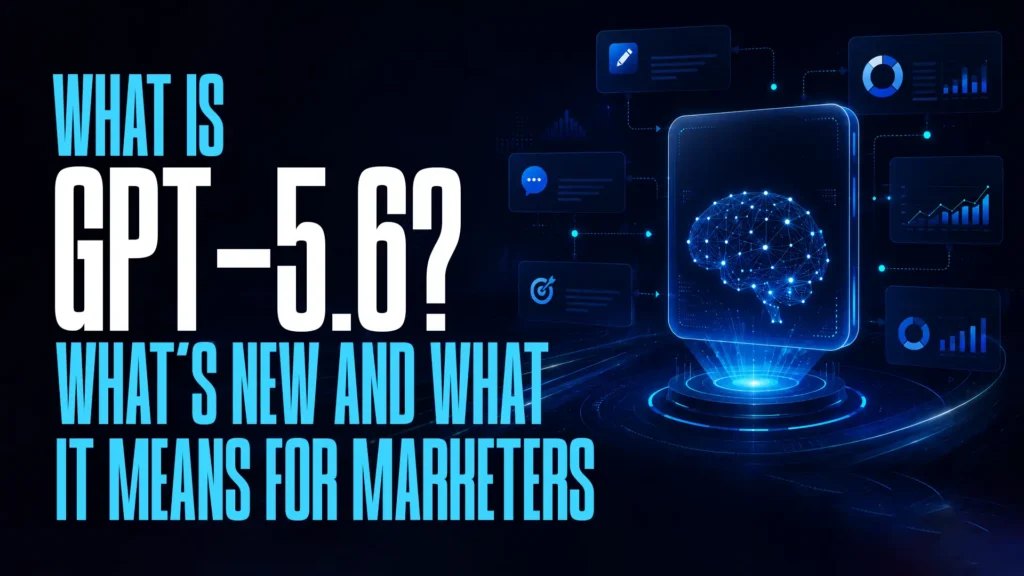
It is built to turn a brief into more complete, ready-to-use work.
OpenAI launched the GPT-5.6 model family on 9 July 2026. It includes GPT-5.6 Sol, Terra and Luna, with each model aimed at a different balance of capability, speed and cost.
For marketers, the important change is not another small improvement in caption writing. GPT-5.6 is designed for longer workflows that combine research, reasoning, tools, design and computer use. That could mean moving from a client brief to campaign positioning, ad copy, presentation slides and landing-page direction with fewer disconnected steps.
But is it a major upgrade for everyone? No. For quick rewrites, simple questions and routine captions, GPT-5.5 Instant remains the practical default. GPT-5.6 matters most when the work is complex, connected and expected to end in a polished deliverable.
| Quick answer: GPT-5.6 is OpenAI’s latest model family. Its biggest improvement is not simply producing better answers. It is designed to complete more of a complex workflow, use tools more efficiently and produce stronger professional outputs such as presentations, documents, spreadsheets, websites and research reports. |
What Is GPT-5.6?
GPT-5.6 is OpenAI’s latest family of advanced AI models. It powers experiences across ChatGPT, ChatGPT Work, Codex and the OpenAI API, but it is not the same thing as ChatGPT.
ChatGPT is the product you use. GPT-5.6 is the model family working inside selected ChatGPT modes and other OpenAI products.
| Model | Best suited for | Main advantage | Where you will see it |
| GPT-5.6 Sol | Complex reasoning, research and professional projects | Highest capability in the family | ChatGPT reasoning modes, Work, Codex and API |
| GPT-5.6 Terra | Regular production work and cost-sensitive workflows | Balance of capability, speed and cost | Work, Codex and API, depending on plan |
| GPT-5.6 Luna | Fast, repeatable and high-volume tasks | Fastest and lowest-cost GPT-5.6 model | Work, Codex and API, depending on plan |
Simple model choice: Use Sol when depth and output quality matter most. Use Terra for capable everyday production work. Use Luna for fast work at scale.
Is GPT-5.6 the Default Model in ChatGPT?
No. GPT-5.5 Instant remains the default for fast, everyday responses. GPT-5.6 Sol powers the Medium, High and Extra High reasoning options on eligible plans, while GPT-5.6 Sol Pro powers the Pro option.
| ChatGPT plan | Medium and High | Extra High | Pro |
| Plus | Included | Not included | Not included |
| Pro | Included | Included | Included |
| Business | Included | Included | Included |
| Enterprise | Included | Included | Included |
| Free and Go | Not included | Not included | Not included |
Terra and Luna are not selectable in standard ChatGPT conversations. They are available through products such as ChatGPT Work, Codex and the OpenAI API, depending on the plan. Availability is still rolling out, and workspace administrators may control access.
What Is New in GPT-5.6 – and Why Marketers Should Care
1. It Handles More of a Connected Workflow
GPT-5.6 is built for long, multi-stage work that combines browsing, analysis, tools, computer use and final output. Instead of treating every prompt as a separate task, it can carry more context and direction across the workflow.
For a marketer, that could look like:
| One connected process Client brief -> Research -> Audience insight -> Positioning -> Campaign idea -> Ad copy -> Reel -> Landing page -> Review |
The benefit is not merely producing more content. It is keeping the same strategy and message across every asset.
2. Presentations, Documents and Spreadsheets Are More Polished
OpenAI says GPT-5.6 can create more refined professional files with stronger hierarchy, spacing, typography and layout. It can also follow an existing presentation template more accurately by recognising its layouts, colours, typography and recurring design rules.
For marketers and agencies, this matters for campaign decks, proposals, monthly reports, research summaries, content plans and sales presentations. It should produce a stronger first draft and reduce basic cleanup. It still does not replace experienced design judgement.
3. Websites and Interfaces Show Better Design Judgement
GPT-5.6 improves frontend aesthetics, layout, visual hierarchy and usability. Its computer-use abilities can also help it inspect and refine the rendered result instead of stopping at code generation.
That makes it more useful for landing-page structure, campaign microsites, dashboards, prototypes and interactive reports. The improvement is not only cleaner code. The finished interface should be more organised and usable.
4. It Can Reach Strong Results with Fewer Back-and-Forth Steps
GPT-5.6 is designed to get more useful work from every token. In tool-heavy workflows, it can process intermediate results, retain what matters and move to the next action with fewer model turns and less guidance.
For regular ChatGPT users, the practical gain may be fewer correction rounds. For teams using the API, better token efficiency can make large-scale research, analysis and content workflows more economical.
5. It Adds More Advanced Tool and Multi-Agent Workflows
For developers and advanced teams, Programmatic Tool Calling allows GPT-5.6 to run lightweight programs that coordinate tools and process intermediate information. A multi-agent beta can divide a complex task among several subagents and combine the results.
A marketing research workflow could assign one agent to competitors, another to customer reviews and another to market trends, then combine the findings into one strategy. Most everyday ChatGPT users will not manage these systems directly, but they may benefit from the stronger workflow technology behind the product.
What GPT-5.6 Changes for Marketers
Marketers do not need another AI that writes one more caption. They need an AI that can hold the same strategy across the ad, reel, landing page, email and presentation.
GPT-5.6 is more useful when you give it the business context, audience, offer, brand rules, campaign objective and success criteria together. It can then help execute several connected parts of the project without forcing you to rebuild the strategy in every prompt.
This does not remove the need for a marketer. The model does not know the customer, commercial pressure or brand history as deeply as the person responsible for the business. GPT-5.6 can be a stronger executor. The quality of the strategy still depends on you.
GPT-5.6 vs GPT-5.5: What Changed?
| Area | GPT-5.5 | GPT-5.6 |
| Everyday tasks | Fast and reliable | Often unnecessary for simple requests |
| Complex workflows | May need more guidance and separate prompts | Handles longer, connected workflows better |
| Design quality | Capable first drafts | Stronger layouts, hierarchy and frontend judgement |
| Tool use | Effective | Better coordination and more advanced tool workflows |
| Efficiency | Strong | Can reach high-quality results with fewer output tokens |
| Best use | Quick writing, rewriting and routine questions | Research, professional deliverables and multi-stage work |
The difference may feel small when you ask for one caption. It becomes clearer when the task involves several files, tools, decisions or stages.
A Practical GPT-5.6 Use Case for a Marketer
Imagine a real-estate brand wants qualified leads for premium residential plots near a major IT hub. The marketer provides the project details, target audience, offer, brand tone, existing creatives and previous campaign data.
GPT-5.6 can then help create:
- Campaign positioning and key message
- Three creative campaign concepts
- Meta ad copy and headline options
- Reel and carousel directions
- Landing-page structure and calls to action
- A testing plan with clear variables
- A final review for consistency and weak ideas
The main benefit is consistency. Every asset can follow the same strategic idea instead of being created through disconnected prompts.
A Sample GPT-5.6 Prompt for Marketers
A strong GPT-5.6 prompt should define the goal, context, boundaries and expected output. It should also tell the model what success looks like.
| You are a senior digital marketing strategist. Create a lead-generation campaign for a premium real-estate project near a major IT hub. Target audience: senior IT professionals, business owners and investors. Campaign goal: generate qualified leads. Brand tone: premium, clear and trustworthy. Use the project details, audience insights and previous campaign data provided below. Create: 1. The strongest campaign positioning 2. Three campaign concepts 3. Meta ad copy 4. One reel concept 5. One carousel structure 6. Landing-page recommendations 7. A simple testing plan Keep the strategy consistent across every format. Before finalising, review the full campaign and remove weak, repetitive or generic ideas. |
| Prompting principle Tell GPT-5.6 what success looks like. Give it the necessary context and boundaries, then allow it to choose a sensible path to the result. |
How to Test GPT-5.6 Against GPT-5.5
Do not compare the models using a one-line caption prompt. Give both models the same complete campaign brief and compare the finished system, not one isolated answer.
Score each output on these five points:
- Strength and originality of the campaign positioning
- Consistency across ad, reel and landing page
- Use of the business and audience context
- Number of corrections needed before the work is usable
- Quality of the final presentation and structure
This test will show whether GPT-5.6 saves meaningful work in your real process, which matters more than a benchmark score.
Who Should Use GPT-5.6?
GPT-5.6 is most useful for marketers building complete campaigns, agencies analysing several client files, designers creating presentations or interfaces, researchers working across multiple sources, developers building advanced workflows and businesses that need polished professional output.
For quick captions, simple rewrites, basic explanations and routine questions, GPT-5.5 Instant is usually enough. Use GPT-5.6 when the task needs deeper reasoning, several tools, multiple decisions or a stronger finished result.
Final Verdict: Is GPT-5.6 a Major Upgrade?
Yes – but the value will not be obvious in every task.
GPT-5.6 is a meaningful upgrade for complex professional work. Its stronger tool use, design judgement, computer use and token efficiency make it better suited to projects that move through several connected stages.
For marketers, the real shift is simple: GPT-5.6 is not only better at answering prompts. It is better at helping turn a good strategy into a complete set of usable assets.
Do not test it with another caption prompt. Give it one complete campaign brief, use the sample prompt above and compare the finished result with GPT-5.5.
| Share this guide with a marketer who still uses AI one isolated prompt at a time. |
Frequently Asked Questions About GPT-5.6
Is GPT-5.6 available in ChatGPT?
Yes. GPT-5.6 Sol is rolling out to eligible paid ChatGPT plans. It powers the Medium, High and Extra High reasoning options, while GPT-5.6 Sol Pro powers the Pro option.
Is GPT-5.6 free?
GPT-5.6 Sol is not included in standard ChatGPT conversations for Free and Go users. Access to Terra may be available through Codex, depending on the product and plan.
Is GPT-5.6 better than GPT-5.5?
GPT-5.6 is stronger for complex reasoning, tool-heavy workflows, professional deliverables and design tasks. GPT-5.5 Instant remains better suited to quick, everyday requests.
What is GPT-5.6 Sol?
GPT-5.6 Sol is the flagship model in the GPT-5.6 family. It is designed for difficult reasoning, coding, research and complex professional workflows.
What are GPT-5.6 Terra and Luna?
Terra balances capability, speed and cost for everyday production work. Luna is designed for faster, lower-cost and high-volume workloads.
Is GPT-5.6 useful for digital marketing?
Yes. Its strongest value is in connected projects such as campaign planning, research, content systems, presentations, landing pages and analysis – not isolated tasks such as one caption.
Official Sources
- OpenAI: GPT-5.6 launch announcement
- OpenAI Help Center: GPT-5.6 in ChatGPT
- OpenAI API documentation: Using GPT-5.6
Source details and plan availability were checked on 11 July 2026. OpenAI may change model access, plan limits and product availability after publication.

This article gave me a clear perspective on the topic while browsing online and I look forward to reading more from you
Excellent blog here Also your website loads up very fast What web host are you using Can I get your affiliate link to your host I wish my web site loaded up as quickly as yours lol