
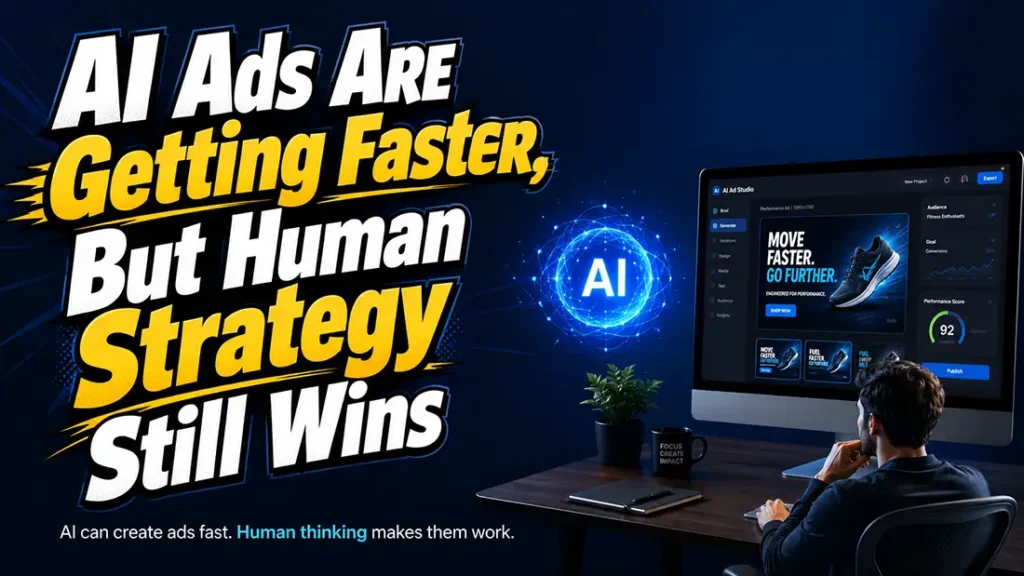
AI ads are no longer a future trend. They are already here.
Brands are using AI to write ad copy, create product visuals, make social media posts, generate campaign ideas, test multiple versions, and speed up everyday marketing work. In fact, global companies are now using AI at their Indian hubs to bring more advertising work in-house, reduce costs, and create campaigns faster. Reuters reported that companies such as Kimberly-Clark, Catalyst Brands, and Target India are using AI for content creation, influencer selection, campaign optimization, and product visuals. In one example, Kimberly-Clark reduced content generation time from 24 days to just two hours using an AI platform.
That is a big shift. But here is the important part. Faster ads do not automatically mean better ads.
AI can help a brand create more. But more is not always meaningful. More ads can also mean more noise. More generic messages. More copy-paste visuals. More content that looks impressive but does not connect.
This is why human strategy still matters. AI can create fast. But humans still need to make it smart.
Why AI Ads Are Suddenly Becoming So Popular
Advertising has always needed speed.
A brand may need different ads for Facebook, Instagram, YouTube, Google, LinkedIn, WhatsApp, email, landing pages, product launches, festivals, offers, retargeting campaigns, and regional audiences.
That is a lot of creative work.
Earlier, even a simple campaign needed many steps. There was a brief. Then copy. Then design. Then review. Then edits. Then approval. Then resizing. Then more versions.
Now AI can reduce a lot of that pressure.
It can help create:
- Ad copy ideas
- Headline variations
- Social media captions
- Product image concepts
- Reel scripts
- Banner concepts
- Carousel structures
- Landing page copy
- Email subject lines
- Campaign angles
- Audience-specific messages
- Testing variations
For marketers, this is useful. For small businesses, this is powerful. For agencies and freelancers, this is both an opportunity and a warning.
Because if basic ad creation becomes faster, the value will move from “I can create an ad” to “I can create the right ad.”
That is a different game.
The Problem: Fast Does Not Always Mean Effective
AI can generate an ad in seconds.
- But will that ad sell?
- Will it stop the scroll?
- Will it match the brand?
- Will it speak to the right customer?
- Will it explain the offer clearly?
- Will it feel believable?
- Will it make someone click, save, inquire, or buy?
That is where many AI ads fail. They are fast, but flat. Sound polished, but empty. They look modern, but generic. Have words, but no sharp idea.
This happens because many people use AI with weak prompts. They ask:
- “Write an ad for my product.”
- “Create a Facebook ad.”
- “Make a caption for my business.”
- “Give me a campaign idea.”
These prompts are too thin.
AI does not know your market unless you explain it. It does not know your brand voice unless you define it. It does not know your customer’s pain unless you describe it. It does not know your offer unless you make it clear.
So it gives a safe answer. Safe answers rarely create strong ads.
The Biggest Risk: Every Brand Starts Sounding the Same
This is the danger. When brands use the same AI tools with the same weak prompts, the output starts looking and sounding similar.
You begin to see the same lines everywhere:
- “Take your business to the next level.”
- “Unlock your true potential.”
- “Experience the future of…”
- “Transform your journey.”
- “Boost your growth.”
- “Elevate your lifestyle.”
These lines sound nice. But they do not say much. They are not wrong. They are just forgettable.
The same thing happens with visuals. Many AI-generated ads use the same glowing backgrounds, perfect product shots, cinematic lighting, floating objects, neon effects, and over-polished compositions.
At first, it looks attractive. Then everything starts feeling the same. That is bad for branding.
Because a brand is not built by looking like everyone else. A brand is built by having a clear point of view, a clear voice, and a clear reason to be remembered.
AI Can Create Output. Strategy Creates Impact.
This is the line every marketer should remember. AI creates output. Strategy creates impact.
Output means the ad exists. Strategy means the ad has a reason.
A strategic ad knows:
Who it is talking to
What problem it is solving
What emotion it is creating
What offer it is presenting
What action it wants
What brand voice it should use
What objection it must handle
What makes it different
What the customer should remember
Without these things, an AI ad is just content. With these things, it becomes communication.
That is the difference between a random ad and a result-oriented ad.
What Human Strategy Adds to AI Ads
AI is powerful, but it needs direction. Human strategy gives that direction. A smart marketer, designer, copywriter, or business owner brings context that AI does not automatically have.
A smart marketer understands the customer deeply. The real skill is knowing what the audience is afraid of, what people compare before buying, and what kind of offer feels believable. It also includes choosing language that sounds natural, protecting the brand from saying the wrong things, and knowing the difference between a clever line and a genuinely useful one. The same judgment applies to visuals too — whether something looks premium, fake, cheap, confusing, or completely off-brand.
This human judgment is extremely valuable. AI can give you ten options.
But you still need to know which one is worth using.
The Smart Way to Create AI Ads
The smart way is not to ask AI for a finished ad directly. The smart way is to give AI a proper creative brief.
Before creating any AI ad, define these six things.
First, define the audience. Who are you trying to reach? Be specific. “Everyone” is not an audience.
Second, define the goal. Do you want leads, sales, awareness, WhatsApp inquiries, website visits, app installs, bookings, or store visits?
Third, define the problem or desire. What does your audience want? What are they struggling with? What are they trying to avoid?
Fourth, define the brand voice. Should the ad sound premium, friendly, bold, expert, emotional, youthful, simple, or direct?
Fifth, define the big idea. What is the main message? Why should someone care?
Sixth, define the CTA. What should people do after seeing the ad?
When these things are clear, AI becomes much more useful.
A Simple Example
A weak prompt would be:
“Write a Facebook ad for my dental clinic.”
This will produce a generic ad. A better prompt would be:
“Act as a senior advertising strategist. I run a premium dental clinic in Pune. I want to create a Facebook ad for working professionals aged 25–45 who delay dental treatment because they are busy or worried about pain. The goal is to get WhatsApp appointment inquiries. The brand voice should be caring, expert, and reassuring. Create 5 ad concepts with headline, body copy, visual idea, CTA, emotional angle, and why each concept may work. Avoid fear-based messaging and keep the language simple.”
This prompt gives AI direction. Now the output will be more specific, more useful, and more relevant.
This is how you move from random AI content to strategic AI ads.
Why Small Businesses Should Care
AI ads can be a major advantage for small businesses. A local business may not have a big creative team. It may not have an expensive agency. It may not have time to create fresh campaigns every week.
AI can help.
- A salon can create festive offer ads.
- A restaurant can create weekend promotion posts.
- A gym can create lead-generation ad copy.
- A real estate consultant can create project-specific campaign ideas.
- A coaching institute can create admission campaign creatives.
- A clinic can create awareness posts and appointment ads.
- A freelancer can create service promotion posts.
But small businesses must avoid one mistake. “Do not sound like a machine.” Your customers want clarity. They want trust. They want proof. They want a real reason to choose you.
So use AI for speed. But add your real details. Add your location, your offer, your customer pain point, your proof, your tone, your story, and your human touch.
That is what makes the ad believable.
What This Means for Designers, Marketers, and Agencies
For creative professionals, AI ads are not just a tool shift. They are a value shift.
Basic execution is becoming faster. Clients may create first drafts themselves. They may generate rough visuals. They may ask AI for captions. They may expect quicker turnaround.
So the old value of “I know how to use the tool” is not enough.
Your new value is not just creating one post or one design. It is in the thinking behind it. It is knowing which idea can work, turning a vague brief into a sharp campaign, building a clear brand voice, improving AI output, and removing weak ideas before they go live. The real advantage is making the ad feel human, useful, and strategic — not just faster.
In the AI era, designers and marketers must become creative directors, not just operators.
That is the real upgrade.
The Smart Creator Checklist for AI Ads
Before publishing any AI-generated or AI-assisted ad, check these points.
- Is the audience clear?
- Is the goal clear?
- Is the headline specific?
- Is the offer easy to understand?
- Does it sound like the brand?
- Is the message different from competitors?
- Does the visual support the message?
- Is the CTA direct?
- Have you removed generic lines?
- Have you checked facts and claims?
- Would a real customer care?
This last question is the most important.
- Would a real customer care?
If the answer is no, the ad needs more thinking.
A Ready-to-Use Prompt for Better AI Ads
Use this prompt whenever you want to create better AI ads.
“Act as a senior advertising strategist and creative director. I want to create an ad for [product/service]. My target audience is [audience]. Their main problem or desire is [problem/desire]. The goal of the ad is [goal]. My brand voice is [brand voice]. The platform is [Facebook/Instagram/Google/LinkedIn/YouTube]. Create 5 different ad concepts. For each concept, give me the headline, body copy, visual idea, CTA, emotional angle, and why it may work. Avoid generic lines and make the ideas specific, practical, and brand-relevant.”
This prompt works because it gives AI a clear role and a clear direction.
It does not ask AI to create randomly. It asks AI to think like a strategist.
Another Prompt for Ad Variations
Once you have one strong ad idea, use this prompt:
“Take this ad concept and create 10 variations for testing. Make 3 versions emotional, 3 versions practical, 2 versions curiosity-driven, and 2 versions offer-focused. Keep the brand voice consistent. Do not change the core message. Give headline, short body copy, and CTA for each variation.”
This is where AI becomes very useful. It helps you test multiple angles faster.
But again, you must choose the best ones. Do not publish all versions blindly.
Another Prompt to Remove Generic AI Language
Use this after generating an ad:
“Review this ad copy and remove generic AI-sounding phrases. Make it sharper, more specific, more human, and more useful for [audience]. Keep the language simple. Add one clear benefit and one stronger CTA.”
This helps reduce robotic content. It also makes the ad more practical.
The Real Future of AI Ads
The future is not that AI will replace all creative people.
The future is that creative people who use AI well will move faster than those who do not.
But using AI well does not mean pressing a button.
It means knowing how to brief AI.
It means knowing how to judge the output.
It means knowing how to improve weak ideas.
It means knowing when to use AI and when to trust human experience.
It means combining speed with strategy.
The people who win will not be the ones who create the most ads.
They will be the ones who create the most relevant ads.
Final Thoughts
AI ads are getting faster.
That is true.
Brands can now create more campaign ideas, more copies, more visuals, and more variations in less time.
But speed is only useful when it moves in the right direction.
A fast wrong ad is still a wrong ad.
A fast generic ad is still forgettable.
A fast polished ad is still weak if it does not connect.
Human strategy still wins because people do not buy from output.
They buy from meaning, trust, emotion, clarity, proof, and relevance.
AI can help you create faster.
But your thinking makes it work.
Don’t just use AI to create faster.
Use AI to think better.
FAQs: AI Ads Are Getting Faster
1. What are AI ads?
AI ads are advertisements created or supported with artificial intelligence. AI can help with ad copy, visuals, campaign ideas, captions, reel scripts, product mockups, and testing variations.
2. Are AI ads effective?
AI ads can be effective when they are guided by a clear strategy. If the prompt is vague and the output is not edited, AI ads can become generic and weak.
3. Can AI replace advertising agencies?
AI may reduce some repetitive creative tasks, but it cannot fully replace strong strategy, brand thinking, creative direction, consumer insight, and human judgment.
4. Why do AI ads often sound generic?
AI ads sound generic when the prompt lacks audience details, brand voice, offer clarity, emotional angle, and specific instructions. Better prompts create better output.
5. How can small businesses use AI ads?
Small businesses can use AI ads for Facebook campaigns, Instagram posts, WhatsApp promotions, Google ads, festival offers, product launches, and local lead generation. But they should always edit and personalize the output.
6. What should marketers learn to create better AI ads?
Marketers should learn prompt writing, customer psychology, creative briefing, ad strategy, brand voice, copywriting, content testing, and AI-assisted workflows.
7. What is the best way to create AI ads?
The best way is to give AI a clear creative brief. Include audience, goal, product benefit, brand voice, platform, CTA, and what to avoid. Then generate multiple options and refine the strongest one.
8. What is the main lesson from AI ads?
The main lesson is simple: AI gives speed, but human strategy gives direction. The best ads will come from people who know how to guide AI intelligently.