
Organic search success metrics in 2026 is not just rankings. It means your pages are easy to index, truly helpful, trusted (E-E-A-T), fast on mobile, visible across modern SERP features (including AI results), and able to drive real outcomes like signups, leads, or sales.
This guide gives you a simple scorecard to measure what matters in organic search success metrics: coverage, quality, performance, and conversions.
Why organic search success metrics changed in 2026
Let’s be honest. For years, SEO success meant one thing: “Did we rank on page one?”
In 2026, that’s not enough.
Because the search results page is not just 10 blue links anymore. Many queries trigger AI experiences like AI Overviews and deeper AI Mode journeys, where the user keeps asking follow-up questions without restarting the search.
Now the important part (and it’s good news):
Google’s guidance is very clear — the same foundational SEO best practices still matter. There are no extra requirements or “special AI SEO hacks” to appear in AI Overviews or AI Mode. If your page is indexed and eligible to show a snippet, it can be eligible to show as a supporting link in these AI features too.
So what changed?
The definition of success shifted from:
“I ranked.”
to:
“I got discovered, trusted, and chosen — even when the user’s journey is partly inside AI answers.”
That’s why your 2026 SEO reporting should stop being a single metric (rankings) and become a scorecard.
The 7 success criteria for organic search in 2026
Here’s the simple truth: if you win these 7, your organic growth becomes stable.
Technical eligibility (you can’t win if Google can’t use your page)
If your page can’t be indexed properly, or can’t show a normal snippet, you’re basically invisible — both in classic search and AI features. AI features still rely on “regular Search eligibility.”
People-first content (content made to help, not to game)
Google keeps pushing one big idea: content should be helpful, reliable, and made for humans first. So your organic search success metrics must include “quality that feels complete,” not just “keywords included.”
Quick self-check:
- Did we add something original (experience, examples, insights)?
- Did we explain the topic fully, not half-way?
That’s the standard now.
E-E-A-T with real experience (proof beats claims)
Google’s rater guidelines thinking adds “Experience” to E-A-T — meaning first-hand use, real testing, real learning matters. In 2026, “I researched it” is okay… but “I did it” is stronger.
Page experience that doesn’t annoy users
Core Web Vitals still matter because they reflect real user experience. Google’s documented targets are clear:
- LCP within 2.5s
- INP under 200ms
- CLS under 0.1
This isn’t about “perfect scores.”
It’s about not losing readers due to slow, jumpy pages.
SERP visibility, not just rankings
In 2026, track where you show up:
- classic blue links
- featured snippets / PAA
- AI Overviews support links
- AI Mode links (where available)
And remember: Google says AI feature traffic is included in Search Console under Web in the Performance report (not a separate bucket).
Conversion quality (business wins, not vanity traffic)
You don’t need 100,000 random visits.
You need the right 10,000.
So success criteria must include:
- email signups
- affiliate clicks
- lead quality
- returning users
Google also explains that signals of helpfulness and trust include things like whether other prominent sites link or refer to you. Brand + references help your long-term authority.
The 2026 Organic Search Scorecard (simple metrics)
In 2026, I like to track organic search like a scorecard, not like a beauty contest.
Because your traffic now comes from “classic search” and AI experiences — and Google counts that AI feature traffic inside your normal Search Console data (it’s not a separate universe).
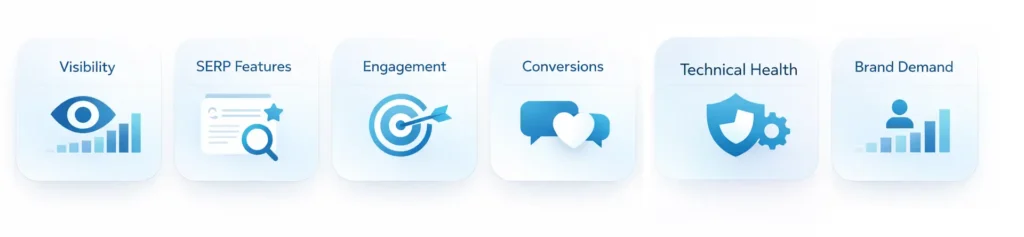
The scorecard (what to track + where)
1) Visibility (are we being seen?)
Tool: Google Search Console → Performance → Web
Track:
- Impressions trend for your key topics (your “topic clusters”)
- Clicks trend (overall + top pages)
- CTR trend (especially for pages sitting in positions 3–10)
- Average position trend (use it as a direction signal, not an ego metric)
Also: remember, AI Overviews / AI Mode visibility is included in the same overall Search Console “Web” reporting.
2) SERP feature coverage (are we showing in rich results/features?)
Tool: Search Console → Performance → Search appearance
Search appearance groups data by the search result feature type.
Track:
- Search appearance clicks/impressions for features you care about (FAQ rich results, product results, videos, etc.)
- Pages earning features (which URLs are winning special layouts)
This is your “visibility beyond blue links” bucket. In 2026, it matters more than ever.
3) Content performance (are people staying and consuming?)
Tool: GA4 (Organic Search channel group)
Track:
- Engagement rate (trend)
- Average engagement time for top landing pages (trend)
- Returning users from organic (this is underrated)
Simple logic: if you’re getting impressions but engagement is weak, you’re not matching intent.
4) Business outcomes (is organic doing real work?)
Tool: GA4 + your ad/affiliate dashboards
Track:
- Key events / conversions from Organic Search (newsletter signup, lead form, WhatsApp click, affiliate click, etc.)
- Conversion rate by landing page (which post actually moves users)
- Revenue proxy (RPM, affiliate EPC, leads quality — whatever fits SocialGyani)
In 2026, traffic without outcomes is just a screenshot.
5) Technical + experience health (is Google confident sending users?)
Tool: Search Console → Core Web Vitals
Core Web Vitals in Search Console uses real user data and groups URLs into Good / Need improvement / Poor for LCP, INP, CLS.
Track:
- Count of Poor URLs (goal: keep pushing this down)
- Biggest URL groups failing CWV (fix the template-level issues first)
Monthly vs weekly tracking rhythm (so you don’t drown)
Weekly (15–20 min): “pulse check”
- Search Console Performance (Web): clicks + impressions trend
- Top 5 gaining pages + top 5 declining pages
- Any sudden CTR drop on important pages (title/meta issue)
Weekly view is useful because it smooths daily noise; Search Console itself recommends weekly/monthly granularity to spot long-term trends.
Monthly (60–90 min): “scorecard review”
- Cluster-wise visibility (are your big topics growing?)
- Search appearance growth (more rich results or not?)
- GA4: organic conversions + best landing pages
- CWV: reduce Poor URL groups
Small but important note: Search Console data usually has a delay, and recent data can be preliminary — don’t panic over the last 1–2 days.
What to stop doing in 2026 (to organic grow)
Let me say this in the most friendly way possible:
A lot of SEO work fails in 2026 not because people are lazy…
but because they’re still playing a 2018 game.
Here are the big things to stop. And yes, I’ll tell you what to do instead.
1) Stop treating rankings as the only “win”
Rankings are still useful. But they’re not the full story anymore.
If you rank #3 and nobody clicks, that’s not a win.
If you rank #9 but your page brings leads and newsletter signups, that is a win.
Do this instead: track clicks, CTR, and conversions — not just position.
2) Stop publishing “me too” content
If your article is basically:
- same headings as top results
- same definitions
- same generic examples
…then why would anyone pick yours?
In 2026, “average” content doesn’t die dramatically.
It just sits there. Quiet. No traffic. No love.
Do this instead: add one of these to every post:
- your real experience (what worked / what failed)
- a mini case story
- screenshots, templates, checklists
- a strong opinion (with reasoning)
3) Stop writing for keywords first, people second
Keyword stuffing is not the only problem.
The bigger problem is this:
Some blogs feel like they were written to “cover words”, not to solve a question.
Readers can feel it in 10 seconds.
Do this instead: write like you’re answering one person who asked you on WhatsApp.
4) Stop pumping out thin pages to “cover more keywords”
This is a silent traffic killer.
10 thin articles don’t beat 1 strong article.
They also create internal competition (your pages fight each other).
Do this instead:
- merge similar posts into one “pillar”
- keep smaller posts only if they truly deserve to exist
- update old winners before you publish new maybes
5) Stop over-optimizing titles like clickbait
“Shocking SEO hack that Google doesn’t want you to know…”
People are tired. And they bounce fast.
You want curiosity, yes.
But you also want trust.
Do this instead: write titles that are clear + specific:
- “Success Criteria for Organic Search in 2026 (Scorecard Inside)”
- “Organic Search Metrics in 2026: What to Track Weekly vs Monthly”
6) Stop ignoring page experience “because content is king”
Content is king. True.
But if your page:
- loads slow
- jumps around
- shows too many ads above the fold
- makes reading painful on mobile
…your great content becomes invisible in practice.
Do this instead: fix template-level issues first (theme, ads, fonts, spacing).
7) Stop publishing without internal links and a clear next step
This one is so common.
A post goes live… and it ends like a dead end.
No next read.Without CTA and No flow.
Do this instead: every post should have:
- 3–5 internal links (contextual, not random)
- 1 clear next step: subscribe, download, contact, or read the next guide
8) Stop updating nothing
Google changes. SERPs change. Your post gets outdated quietly.
If you don’t refresh your best posts, you slowly lose the easiest traffic you could’ve kept.
Do this instead: update winners on a schedule:
- refresh stats
- add new examples
- improve intro + snippet section
- tighten the “scorecard” section
Quick 30-Day Action Plan (to hit the organic search success metrics 2026)
This is the part most people skip.
They read about “new SEO”, nod their head, and then… do nothing on Monday.
So here’s a simple 30-day plan you can actually follow. No drama. Just progress.
Week 1: Fix the “eligibility + trust” basics (foundation week)
Goal: make sure your best pages are easy to crawl, easy to trust, and easy to show in search.
Do these 5 actions:
- Pick your top 10 pages (the ones that already get impressions/clicks in Search Console).
- For each page, improve the first 15 lines:
- add a crisp answer (AEO snippet style)
- make the topic clear immediately
- Add Experience proof on those pages:
- a mini story (“what I tried”, “what worked”)
- a screenshot / template / checklist (anything original)
- Add a mini author box (even 2 lines helps): who you are + why you’re credible for this topic.
- Add 3–5 internal links from each of those pages to related posts.
If you do only this week properly, you’ll already feel your blog becoming “stronger.”
Week 2: Upgrade content into “clusters” (growth week)
Goal: stop publishing random standalone posts and start building topical authority.
Do this:
- Choose one main theme
- Create:
- 1 pillar post (the main guide)
- 3 supporting posts (narrow, focused topics)
- Add a “Next Read” section at the end of each supporting post:
- “If you liked this, read: [pillar post]”
- Create one simple internal linking rule:
- supporting posts must link to pillar
- pillar must link back to all supporting posts
This is how you build a blog that compounds.
Week 3: Improve CTR + user satisfaction (momentum week)
Goal: get more clicks from the same impressions, and keep readers longer.
Do this:
- In Search Console, find pages with:
- high impressions
- low CTR
- Rewrite only 2 things:
- Title: make it clearer, more specific, more “benefit-driven”
- Meta description: promise what the reader will get (in simple words)
- Add “scroll juice” to the content:
- short paragraphs
- one small list every few sections
- a mini example box (“Real example: …”)
- Add one clear CTA:
- subscribe / download / WhatsApp / read next guide
This week gives quick wins because CTR is often the easiest lever.
Week 4: Make organic outcomes measurable (business week)
Goal: prove that organic search is not just traffic — it’s business.
Do this:
- Decide your “organic conversions”:
- newsletter signup
- affiliate click
- contact/lead form
- WhatsApp click
- Track them in GA4 as key events (or at least track clicks).
- Update your top pages:
- place CTA after the first 30–40% of the article (not only at the end)
- add a simple offer: “Free checklist / Free template / Download”
- Create a monthly habit:
- update 2 old winners
- publish 1 new supporting post
- improve internal links every time you publish
That’s compounding SEO.
The 30-day target (what “good progress” looks like)
By day 30, aim for:
- improved CTR on at least 3 pages
- 10–20 new internal links across key posts
- 1 pillar + 3 supports connected as a cluster
- 1–2 conversions clearly tracked from organic
You don’t need perfection. You need consistency.
Conclusion: Organic search success metrics 2026
If you take only one thing from this blog, take this:
In 2026, organic search success is not a single number.
It’s a system.
A system where your content gets discovered, understood, trusted, and chosen — even when the journey starts inside AI answers and ends on your website.
So don’t chase random rankings.
Build a strong base. Write content that feels complete. Show real experience. Fix page experience. Link your content properly. And measure outcomes, not just traffic.
Because the best SEO in 2026 is not “smart tricks.”
It’s consistent quality + clear proof + simple tracking.
And once you do that, organic growth becomes less stressful… and more predictable.
FAQs: Organic search success metrics 2026
1) Is ranking still important in 2026?
Yes. But rankings alone don’t tell you the full story. Track clicks, CTR, and conversions too. A page that ranks lower but brings signups is more valuable than a page that ranks higher and does nothing.
2) What are the most important metrics to track for organic search success?
Keep it simple:
- Search Console: clicks, impressions, CTR, top pages
- GA4: engagement + conversions from organic
- Core Web Vitals: reduce “Poor” URL groups
3) How do I measure visibility in AI results like AI Overviews?
You measure it mainly through your overall Search Console performance trends (clicks/impressions/CTR). Treat AI visibility as part of your total search presence, not a separate channel.
4) Do I need special optimization for AI Mode or AI Overviews?
No “special hack.” Focus on the basics that make your page easy to use: clear structure, helpful answers, strong credibility, and clean technical SEO. If your page is eligible for normal Search results, it can be eligible in AI experiences too.
5) What matters more in 2026: traffic or conversions?
Conversions. Always.
Traffic is useful, but only if it brings the right people and leads to real outcomes: signups, leads, affiliate clicks, revenue, or brand demand.
6) Should I publish more content or update old content in 2026?
Update old winners first. It’s usually the fastest growth lever. Then publish supporting articles that strengthen your topic clusters.
7) What’s a simple weekly SEO routine for bloggers?
Once a week:
- check Search Console performance trend
- spot top gainers and losers
- improve titles/meta for low-CTR pages
- add internal links to your best posts