
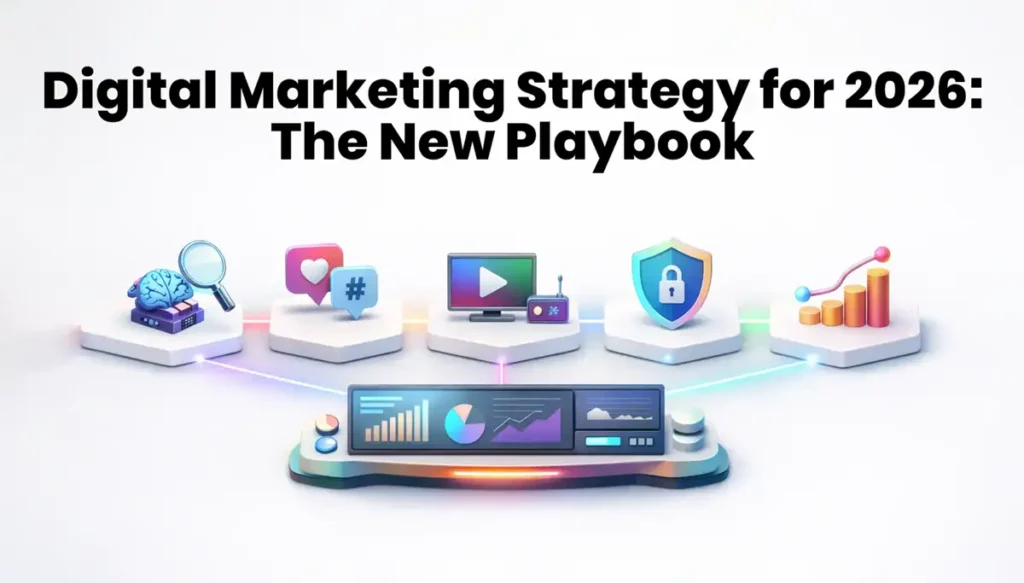
Digital marketing strategy for 2026 starts with one uncomfortable idea:
your plan won’t fail because you’re “bad at marketing.” It will fail because you’re still playing the old discovery game.
In 2026, a digital marketing strategy for 2026 should be intent-first: win AI search (GEO + AEO), use Social SEO and video for discovery, build proof for trust, capture first-party data, and connect everything to CRM so leads turn into revenue.
Let’s build this playbook step by step.
Hook + Reality Check: You didn’t lose rankings… you lost attention
Imagine.
You publish a blog.
It ranked.
Your team celebrated.
Then… nothing happened. No leads…. No calls.
You check Analytics again. Still decent traffic.
But the phone is quiet.
That’s the 2026 problem in one scene.
Because people may discover you without ever clicking you. They get summaries from AI, they watch one short video, they read comments, they see a creator’s quick review… and they decide.
What’s actually changing (simple version)
- Search is becoming answer-led, not just link-led. AI tools synthesize and guide decisions.
- Social platforms behave like search engines for “best”, “how-to”, “review”, “vs”, “price”, “worth it”.
- Video is not only awareness anymore. It can move people from curiosity to purchase fast.
So the goal for 2026 is not “more content” or “more ads.”
The goal is: be present at the moment of intent—wherever that moment happens.
The Big Shift: From Keywords to Intent
Keywords still matter. Of course.
But keywords are like street names.
Intent is the destination.
In 2026, the winning brands don’t ask, “What keyword should we rank for?”
They ask, “What is the person trying to do right now?”
Because discovery is happening across AI assistants, social, and video—not only on Google.
What “intent-first marketing” really means
It means your brand presence, media, and funnel work like one system—built around intent, not channels.
So instead of planning like this:
- SEO team does SEO
- Social team does social
- Ads team does ads
- Sales team asks “these leads are weak”
You plan like this:
Intent → content → distribution → capture → nurture → close
The 4 intent types you should build around
Keep it super practical:
- Learn intent (they’re curious)
- “What is ___?” “How does ___ work?”
- Compare intent (they’re shortlisting)
- “___ vs ___” “Best ___ for ___”
- Buy intent (they’re ready)
- “Pricing” “Demo” “Near me” “Book”
- Fix/Support intent (they want success)
- “Setup” “Troubleshoot” “Best practices”
If you cover only Learn intent, you’ll get views… and still feel broke.
If you cover only Buy intent, you’ll look pushy and thin.
The magic is the full set.
AI Search Playbook: Beyond the Blue Links
In 2026, ranking is not the finish line.
Sometimes, it’s not even the start.
Because Google can show an AI Overview (and now AI Mode in some places) that gives a full summary with links… and the user may get what they need without clicking 10 blue links
That’s why the Entrepreneur article calls it out clearly: visibility is no longer guaranteed just because you rank. Brands must be structured so machines can find, understand, and trust them.
So your 2026 job is simple to say, but tough to do:
Become the source that AI wants to cite.
First, quick clarity: AEO vs GEO
AEO (Answer Engine Optimization)
You format content so it can be used as a clean answer: direct, structured, easy to quote.
GEO (Generative Engine Optimization)
You make content “AI-friendly” so generative systems (AI Overviews, chatbots, assistants) can understand it and include it in their responses.
Think like this:
- AEO = answer format
- GEO = answer visibility + citations
How AI search works
Google says AI Overviews and AI Mode may use a “query fan-out” approach — multiple related searches across subtopics — to build a response and show a wider set of supporting pages.
What this means for you:
You can’t rely on one perfect keyword page anymore.
You need clear coverage + strong structure + real proof.
The 2026 AI Search Playbook
Step 1: Be eligible (boring, but critical)
Google’s guidance is blunt: no special hacks are required for AI Overviews/AI Mode. You still need solid SEO fundamentals.
Your page must be:
- indexable
- eligible to show a snippet
- technically clean
And yes, structured data should match visible content.
Step 2: Put the “best answer” early (answer-first writing)
AI systems love clarity. Humans also love clarity.
So give a direct answer in the first few lines.
This formula (works insanely well):
- 1 line: definition / direct answer
- 3–5 bullets: key points
- 1 example: real-life proof
- then the long explanation
This is AEO basics, but it also supports GEO because it’s easy to pick up and cite.
Step 3: Write for scanners and machines (structure is your superpower)
This is where most blogs fail.
They write like a school essay.
AI hates that. People hate that too.
Do this instead:
- short paragraphs (2–3 lines)
- clean H2/H3 headings
- lists where needed (not everywhere)
- simple tables when comparing options
- keep important content in text, not only inside images
Step 4: Build “trust blocks” (proof beats promises)
If your content sounds like generic AI fluff, you won’t win AI search.
Google keeps pushing “helpful, reliable, people-first content.”
And Google’s own guidance on AI content is basically: AI is fine, but quality + originality + E-E-A-T matters.
So add proof like a grown-up brand:
Trust block ideas (pick 2–3 per article):
- mini case study (what changed, what improved)
- screenshots (Search Console, GA4, ads dashboard)
- a small “what we tested” section
- real examples, not theory
- sources / references (where your facts came from)
This one section alone can make your content feel 10x more “cite-worthy”.
Step 5: Become an “entity”, not just a website
AI answers prefer clear identities:
- Who wrote this?
- What brand is this?
- Why should anyone trust it?
Google specifically mentions keeping key business info up to date (like Business Profile / Merchant Center where relevant).
Practical actions:
- strong About page (who you are, what you do)
- author bio on every article (with real experience)
- consistent brand name everywhere
- same service names across pages (don’t keep renaming)
This is one of those boring things that quietly wins.
Step 6: Create “citation magnets” (content AI loves to quote)
These formats tend to get pulled into answers:
- Definitions: “X is…”
- Step-by-step: “How to…”
- Comparisons: “X vs Y”
- Best-for pages: “Best X for Y”
- Troubleshooting: “If X happens, do Y”
If you publish these consistently, your GEO footprint grows over time.
Step 7: Measure it like 2026 (not like 2018)
Google notes that AI feature traffic is included in Search Console’s overall reporting (it’s not a separate magical report).
So what you track instead:
- query themes (what questions bring impressions)
- pages that earn impressions but low clicks (update answer block)
- brand queries trend (are people searching you by name?)
- conversions from search (not just traffic)
AI-Ready Page Template: Use this layout for your key pages:
- One-line answer (definition)
- 80–120 word “direct answer” paragraph
- 3–5 bullets: key takeaways
- Step-by-step section
- Real example / proof block
- Comparison / table (if relevant)
- FAQs (5–7 questions)
- Sources / references
- Author box + Last updated date
This is AEO-friendly and GEO-friendly at the same time.
Quick “don’t do this” list (AI search killers)
- long intros with no answer
- fluffy generic paragraphs that could fit any blog
- no examples, no proof, no sources
- hidden key info inside an infographic only
- outdated pages with no update signals
Social SEO: Social Platforms Are Search Engines Now
Let’s be honest.
When people want a quick answer in 2026, many won’t open Google first.
They open Instagram, YouTube, TikTok, even LinkedIn.
They search like this:
- “best laptop for editing”
- “Dubai real estate worth it?”
- “how to run Meta ads”
- “Canva vs Figma”
- “branding tips for beginners”
This is exactly why your digital marketing strategy for 2026 can’t treat social as “just posting.” Social is now discovery. Social is search.
What Social SEO means (simple)
Social SEO = optimizing your social content so it shows up when people search inside the platform, and when the algorithm recommends content around a topic.
So it’s not only “going viral.”
It’s “getting found on purpose.”
Why this matters in 2026
Because the funnel got shorter.
People do this:
- Search on social
- Watch 2–3 videos/posts
- Read comments
- Decide who they trust
- Then click (maybe)
If your brand is missing in steps 1–4, you’re fighting late.
The Social SEO Playbook
1) Start with “topic clarity” (not random content)
Most brands post like a newspaper. Today this, tomorrow that.
That confuses search and the algorithm.
In 2026, you want to be known for 3–5 topics.
Example (for digital blog):
- AEO / GEO / SEO
- LinkedIn growth
- AI tools for marketing
- Content systems (repurposing)
- Analytics and measurement
Same topics. Repeated. Different angles.
That repetition builds authority.
2) Optimize your profile like a landing page
People discover one post… then they check your profile.
So make it searchable:
- Name field: include your main topic (example: “Social Gyani | AI Marketing + SEO”)
- Bio: 1 line about who you help + result
- Pinned posts: 3 best “starter” posts (beginner friendly)
- Link: one clean link (blog / lead magnet / services)
Treat your profile like your homepage.
3) Use “search language” in captions (stop writing poetic captions)
This is the easiest win.
People search in normal words.
So write in normal words.
Bad caption: “A few thoughts on growth…”
Better caption: “How to optimize content for AI search in 2026 (GEO + AEO)”
Do this often:
- “how to…”
- “best…”
- “mistakes…”
- “checklist…”
- “template…”
- “X vs Y…”
- “for beginners…”
It matches how people type (and talk).
4) Put keywords in 3 places (every time)
For short videos / reels / YouTube shorts:
- On-screen text (first 2 seconds)
- Spoken line (say the phrase once)
- Caption (repeat it naturally)
Example:
- On-screen: “Social SEO in 2026”
- Spoken: “Here’s how social SEO works in 2026…”
- Caption: “Social SEO in 2026: 5 things to do…”
This creates strong topic signals.
5) Build “topic clusters” as series (this is the cheat code)
Platforms love consistency.
So don’t post one random tip.
Create a series.
Examples:
- “AI Search Basics (Part 1/2/3…)”
- “LinkedIn Growth Mistakes (Episode 1…)”
- “Marketing Templates You Can Copy (Week 1…)”
On YouTube: use Playlists.
Instagram: use Guides / Highlights.
LinkedIn: use a consistent post headline format.
This helps both discovery and binge watching.
6) Comments are part of Social SEO (seriously)
When a post gets comments, people read them like reviews.
So use comments smartly:
- reply with short, helpful answers
- repeat the topic once in a natural way
- pin the best Q&A comment
- pin your “next step” link if the platform allows
Example reply:
“Yep — for Social SEO, keep the keyword in your on-screen text + caption. That helps search discovery.”
This keeps your post “about the topic” even after publishing.
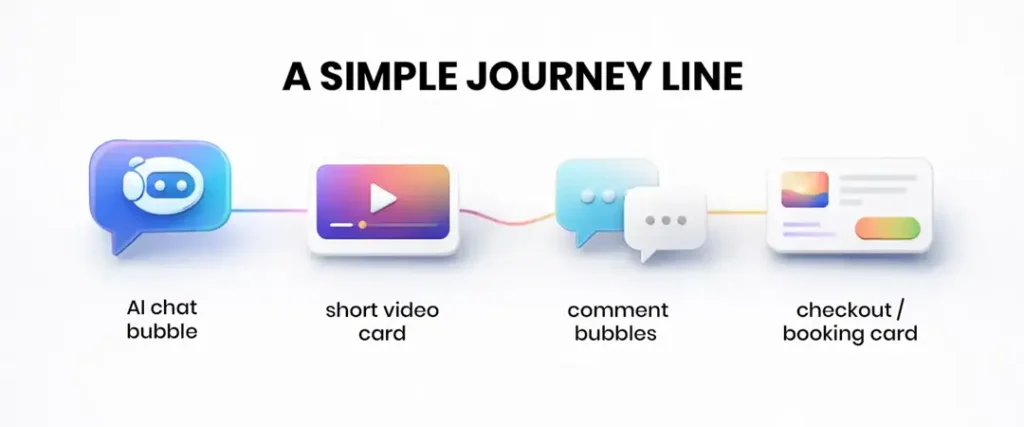
Social Commerce + Video: The Funnel Gets Shorter
In 2026, the buyer journey is less like a “funnel”… and more like a slide.
People don’t want to read 10 pages, then fill a form, then wait.
They want to watch something, trust you fast, and act.
And social platforms make that easy: video + comments + creator proof + a link (or even checkout) in the same place.
So your playbook changes from:
“Create awareness on social, convert on website”
to
“Create trust on social, convert wherever the intent happens.”
What’s really happening
Your customer can now do all of this in 3 minutes:
- Search a topic on Instagram/TikTok/YouTube
- Watch 2 short videos
- Read comments
- Click a product/service link (or message you)
- Buy / book / join
That’s why the funnel feels shorter.
Video is the new salesperson.
It answers questions before they ask you.
The 2026 Social Commerce Playbook (practical)
1) Match video type to intent (this is the secret)
Don’t post random reels. Post by intent.
Learn intent (top of funnel)
- “What is X?”
- “How X works”
- “3 beginner mistakes”
Compare intent (mid funnel)
- “X vs Y”
- “Best option for Z”
- “Which one should you choose?”
Buy intent (bottom funnel)
- “Pricing explained”
- “What you get in the package”
- “Client result / case study”
- “Book a call / DM me”
Support intent (retention)
- “How to use it”
- “Setup tutorial”
- “Fix common problems”
If you do only Learn videos, you’ll get views but not money.
If you do only Buy videos, people will skip you.
You need a mix.
2) Use the “Proof Sandwich” in every conversion video
This is a simple structure that converts without sounding salesy:
Hook → Proof → Offer → Next step
Example (for a service):
- Hook: “If your leads are dropping even with good SEO, this is why.”
- Proof: “Here’s what changed after we added AEO + proof blocks.”
- Offer: “We do a 14-day content upgrade sprint.”
- Next step: “Comment ‘SPRINT’ and I’ll share the checklist.”
People love clarity. They hate pressure.
3) Make your content “shoppable” even if you don’t sell products
Social commerce is not only eCommerce.
Service businesses can do it too.
How service brands do social commerce in 2026
- DM-based selling (“Send me the word…”)
- Calendly/booking link
- WhatsApp click-to-chat
- Mini landing page + one clear CTA
- “Starter pack” offer (easy entry product/service)
Your job is to remove friction.
4) Creator + UGC style content is not optional now
In 2026, people trust people.
So even if you’re a brand, your content should look more like:
- real demos
- real reactions
- real use cases
- real results
UGC formats that work
- “I tried X for 7 days…”
- “Before/after”
- “3 things I noticed”
- “Would I recommend it? Yes/no + why”
You can create this yourself, or collaborate with creators.
5) Build a “one-click path” from video to action
Every conversion-ready video should have one next step only.
Pick one:
- Book a call
- Download a template
- DM a keyword
- Visit a landing page
- Subscribe
Bad: “Like, follow, comment, share, visit website, join newsletter…”
Good: “DM ‘GUIDE’ and I’ll send the checklist.”
What to post each week (simple weekly system)
Here’s an easy rhythm you can repeat:
- 2 Learn videos (tips, myths, basics)
- 1 Compare video (X vs Y, best-for)
- 1 Proof video (case study, result, testimonial)
- 1 Offer video (what you do, pricing, how to start)
That’s 5 pieces. Very doable.
What to track (so it becomes a business channel)
Forget vanity metrics first. Track intent signals:
- Saves + shares (people found it useful)
- Comments with questions (purchase intent)
- DMs (hot intent)
- Profile visits (interest)
- Link clicks + bookings (revenue signal)
If you’re getting saves but no DMs, you’re too educational.
And if you’re getting views but no saves, you’re too shallow.
If you’re getting DMs but no closes, your offer or pricing page needs work.
6) AI Content Workflow (But Human POV Wins)
In 2026, AI can help you write faster.
But speed is not the problem anymore.
The internet is already full.
The real problem is this: Most content sounds the same.
So yes, use AI. Use it hard.
But your advantage is still human:
Your taste, your judgment. Your story and your point of view.
That’s how you win.
The 2026 rule: AI creates the draft. You create the trust.
Think of AI like a junior intern who works 24/7.
It can:
- research fast
- organize ideas
- suggest angles
- generate variants
But it cannot:
- show real experience
- take a brave stance
- tell your story like you lived it
- add proof from your work
That second list is what makes people buy.
The “Content Repurposing Ladder” (so one idea becomes many)
Here’s a smart 2026 workflow:
One core idea → 1 pillar blog → 10 micro assets
Example:
- Pillar blog (SEO + GEO friendly)
- LinkedIn post (POV + lesson)
- LinkedIn carousel (framework)
- 2 short videos (hook + tip)
- Instagram carousel (checklist)
- Newsletter (story + CTA)
- 5 “quote cards” (key lines)
The goal: distribution, not endless creation.
The AI prompt flow you can reuse
Use this exact flow with any topic.
- Research prompt
“Give me 30 questions marketers ask about [topic] in 2026. Group them by Learn/Compare/Buy/Support.” - Outline prompt
“Create a blog structure with SEO + AEO + GEO layout. Add an answer block, proof block, and FAQs.” - Draft prompt
“Write section-by-section in simple English. Use small paragraphs. Mix some bullets. No fluff.” - POV prompt (your favorite one)
“Rewrite with a strong human POV. Add one story, one opinion, and one tradeoff. Avoid generic lines.” - Repurpose prompt
“Turn this blog into: 1 LinkedIn post, 1 carousel outline, 2 short video scripts.”
This makes your content machine run like clockwork.
Quality checklist (quick, brutal, useful)
Before you publish, ask:
- Does the first screen answer the question clearly?
- Did I add at least one proof block?
- Is there a strong POV line?
- Would this still be useful if AI summarized it?
- Did I repurpose it into at least 3 assets?
If “no” to any, fix it before posting.
Biggest mistake in 2026
Using AI to produce more content…
…without building trust.
Quantity won’t save you now. Credibility will.
Privacy-First, Measurement-Ready Stack
Here’s the weird part about Digital Marketing strategy for 2026.
Even when you do marketing right… tracking can still look “wrong”.
Not because you messed up.
Because the web is more private, browsers block more, and platforms don’t share like they used to.
And one more thing: the “cookie death” story didn’t end the way marketers expected. Google has said it won’t roll out a new standalone prompt and is keeping third-party cookie controls in Chrome settings, instead of fully removing cookies.
So the 2026 goal is not “track everything.”
The goal is: track enough, legally, and in a way you can trust.
Let’s build that stack.
The 2026 mindset: Consent + Control + Clean data
Privacy-first doesn’t mean “no measurement.”
It means:
- You ask permission properly
- You collect only what you need
- You keep the data clean
- You measure outcomes, not vanity clicks
FAQs: Digital Marketing Strategy for 2026
1) What is the best digital marketing strategy for 2026?
Intent-first. Build content for AI search + social search, use video for trust, and connect it to CRM for conversion.
2) Is SEO still worth it in 2026?
Yes, but SEO alone is not enough. You need AEO/GEO structure and proof so your content can be used in answers and comparisons.
3) What is Social SEO and how do I start?
Social SEO means optimizing posts to show up in platform search. Start with 3 topics, keyword-led covers/captions, and consistent series.
4) Do I need to be on every platform?
No. Pick 1–2 high-intent platforms and go deep. Consistency beats scattered posting.
5) How do I avoid AI-generated content sounding generic?
Use AI for drafts, but add your POV + real examples + proof blocks. That’s what builds trust.
6) What should I track if attribution is messy?
Track intent signals, conversions, qualified leads, and pipeline. Use lift tests and CRM outcomes, not just clicks.


Pingback: Social Search Optimization 2026: TikTok, IG, YouTube | Social Gyani