How Generative AI is shaping digital marketing is by helping marketers create content faster, test ads at scale, personalize messaging, improve customer support, and turn insights into action. It does not replace marketing strategy, but it changes the speed and quality of execution. The brands that win will use AI to move faster while staying accurate, human, and consistent in brand voice.
A quick story
Imagine you are launching a new product next Monday.
Old way:
You’d spend days writing content, designing creatives, planning emails, and building landing pages. Then you run ads and pray the copy works.
New way (with generative AI):
In a few hours, you can draft the blog, write 30 ad hooks, generate 10 headline options, create email sequences, and even map a chatbot flow. Then you spend your time on the important part: choosing the right message, adding proof, and polishing the brand voice.
This is the shift.
Not “AI makes content.”
But “AI removes the slow steps so you can focus on results.”
That’s the real reason generative AI in digital marketing is changing the game. This is how Generative AI is shaping digital marketing
What is Generative AI in Digital Marketing?
Generative AI is a type of AI that can create new content such as text, images, videos, audio, and even code. In marketing, it works like a smart assistant that helps you draft, brainstorm, and produce faster.
It can help you:
- write a first draft in minutes
- create more variations for testing
- personalize messaging for different audiences
- turn customer insights into better copy and content
But one thing is very important:
AI can generate. It cannot guarantee truth.
So strategy, facts, and final quality still need a human.
The biggest marketing change: speed + scale
Generative AI gives you two superpowers:
1) Speed: You can create faster than before.
2) Scale: You can create many versions, not just one.
That means marketing becomes less about “guessing.”
It becomes more about testing, learning, improving.
But there’s a catch.
When everyone can create quickly, the internet fills with similar posts, similar captions, similar “AI tone.” People scroll past.
So the new advantage is not speed alone.
The advantage is speed + originality + proof + clarity.
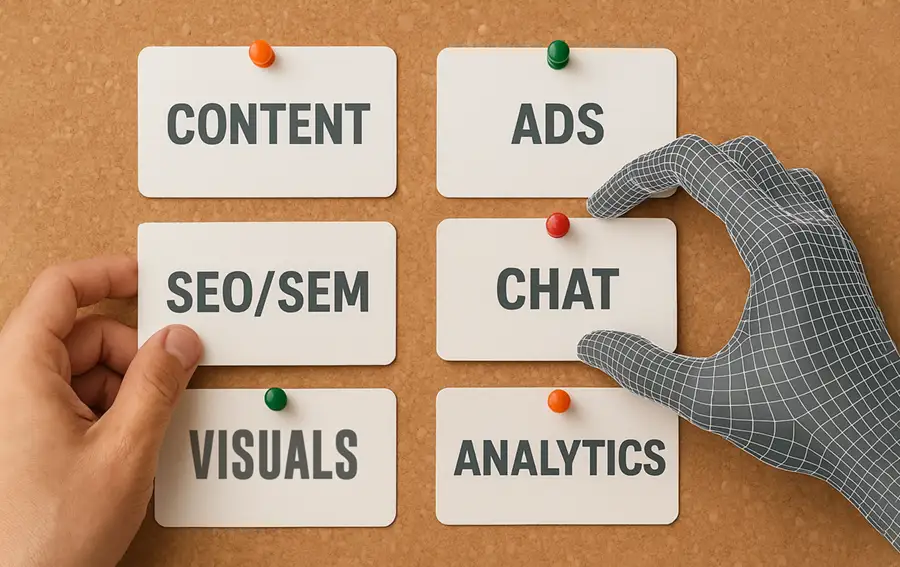
How Generative AI is Shaping Digital Marketing (Real Impact Areas)
1) Content creation is faster, but “usefulness” is the new ranking factor
Yes, AI can write: Blogs, captions, scripts, email drafts, product descriptions, landing page sections.
This saves time. Huge time.
But content that wins is not just written fast.
It is written with a clear purpose.
A simple way to keep your content strong:
- Use AI for the draft
- Add your real examples
- Add your opinions
- Add your brand voice
- Make it easy to scan
- Make it easy to trust
If you publish raw AI content, it often looks like this:
- too general
- too safe
- too many common phrases
- no real story
- no sharp point
So the right workflow is: AI drafts → you sharpen.
2) Paid ads are becoming a testing engine
This is one of the biggest reasons marketers love AI.
Because ads need variations.
Not one copy, not one creative, not even one hook.
With generative AI, you can quickly generate:
- 20 hooks
- 10 headline options
- 10 primary texts
- 6 CTAs
- 5 angles
But here’s how smart teams use it.
They don’t test 50 random ads.
They test 10 ads with 10 clear ideas.
Example angles you can test (small list, big value):
- Problem-solution
- Before-after
- Myth-busting
- Social proof
- Expert tip
- Urgency/limited offer
- Story-based (mini narrative)
- Comparison (X vs Y)
Then your data tells you what to scale.
This is how generative AI in digital marketing improves performance:
more experiments, faster learning.
3) SEO is evolving into SEO + AEO
Search is not only “10 blue links” anymore.
Today, people also search inside:
- AI-powered answers (like chat-based tools)
- Google AI summaries (AI-driven results)
- voice search and assistant-style answers
That’s where AEO comes in.
What is AEO in simple words?
AEO means writing your content so it can be used as a direct answer.
So you do things like:
- define key terms early
- answer the main question in the first 80–120 words
- use clean headings
- write short paragraphs
- add FAQs that match real questions
This blog itself is written that way.
Because how generative AI is shaping digital marketing is not only about tools.
It’s also about how content is discovered.
4) Personalization is moving from “segments” to “people”
Let’s say you run a skincare brand.
Two people visit your website on the same day.
One person lands on your page from a “best sunscreen” search, reads for 20 seconds, and leaves. They are curious, but not ready.
Another person comes from your Instagram retargeting ad, checks reviews, adds to cart… and stops at the payment page. They are not curious. They are close.
Now here’s the problem with old-school personalization: it would often treat both people the same because they fall into the same “segment.”
Same age group, same city, same interest.
So they get the same email. Same message. Same offer.
And you wonder why conversions don’t move.
This is exactly where generative AI in digital marketing is changing the rules.
Instead of “one message for a segment,” you can now create multiple versions of the same message, based on what the person is doing and what they seem to need at that moment.
You’re not changing your brand. You’re changing the entry point.
What “people-based personalization” looks like in real life
- When someone is cold, your message has to be lighter. More educational. Less pushy.
- When someone is warm, your message can be direct. More proof. More clarity.
- When someone is hot, your message should remove friction. Answer objections. Offer confidence.
That’s the shift:
personalization by intent, not just demographics.
A small list that makes this easy to understand:
- A cold audience needs context (what it is, why it matters)
- A warm audience needs trust (proof, reviews, comparisons)
- A hot audience needs confidence (guarantee, clarity, urgency, easy steps)
Where generative AI makes this practical
In the past, writing all these variations was time-consuming. You would either skip it or keep it minimal.
Now, AI can help you create several versions quickly, while you still control the final tone and truth.
And the best part is: you don’t have to personalize everything everywhere.
You only need to personalize the points where it impacts decisions.
That’s why personalization “shines” in high-impact places like:
- email subject lines and opening lines (first impression)
- WhatsApp flows (fast, conversational nudges)
- landing page sections (message match)
- retargeting ad copy (objection handling)
- product pages (benefits written for different needs)
Keep it human (this matters more than tech)
There’s a thin line between “helpful” and “creepy.”
Helpful feels like:
“Hey, looks like you may be comparing options—here’s a simple guide.”
Creepy feels like:
“We saw you looked at this product 7 times. Why didn’t you buy?”
So the rule is simple:
Personalization should feel like good service, not surveillance.
If you write this section into your blog, it will read smoother, feel more human, and still stay SEO/AEO friendly.
5) Customer support is turning into conversion support
A visitor lands on your product page at 11:30 PM. They like the product. They’re almost ready. But one small doubt stops them:
“Is this safe for sensitive skin?”
“How many days for delivery?”
“What if it doesn’t suit me?”
In the old setup, they had two options: wait for support… or leave.
This is where generative AI is shaping digital marketing in a very real way. Customer support is no longer only about solving problems. It’s now part of the sales journey—because fast, clear answers remove friction.
A well-trained AI assistant on your website or WhatsApp can:
- answer FAQs instantly
- suggest the right product or plan
- handle common objections (price, trust, returns)
- capture leads and book calls/demos
The impact is simple: less confusion, fewer drop-offs, more conversions.
But don’t let it become “robot sales.”
Keep two rules:
- Be honest. Never promise what your business can’t deliver.
- Know when to hand over. For complex cases, move to a human quickly.
Done right, support becomes your quiet closer—available 24/7, without sounding pushy.
Example (real-life):
A D2C skincare brand noticed a pattern: people were adding products to cart but dropping off at the last moment. Most questions were repetitive—“Is it safe for sensitive skin?”, “What’s the return policy?”, “How long is delivery?”
They added a simple AI assistant trained only on their FAQ, ingredient notes, shipping rules, and return policy, and connected it with a clean WhatsApp follow-up flow using approved templates. The result was not “magic growth”—but fewer doubts, faster answers, and smoother checkouts, especially at night when human support was offline.
6) Visual marketing is changing
Earlier, visual marketing had a hard limit.
You had an idea in your head… but to see it, you needed time, a designer, and a few rounds of back-and-forth. By the time the first draft came, the trend might already be cold.
This is another clear way generative AI is shaping digital marketing: it makes the visual concept stage insanely fast.
Now, instead of debating a creative in meetings, you can see options in minutes:
- different styles (minimal, premium, playful, cinematic)
- different moods (warm, bold, pastel, dark)
- different layouts (product-first, lifestyle, text-led, UGC vibe)
And that changes everything. Because your team stops guessing and starts choosing.
Here’s the key point: AI isn’t replacing good design.
It’s removing the slow first step.
Where AI helps most:
- moodboards and campaign directions
- ad creative variations for testing
- thumbnail and banner concepts
- quick social template ideas
Then your designer (or you) does the real magic: brand consistency, clean typography, polished layouts, and “this feels premium” finishing.
So the winning combo looks like this:
AI for exploration. Humans for taste. Brand for trust.
7) Strategy becomes sharper when AI reads your customer voice
Most marketing “strategy” fails for one simple reason.
We write what we think people care about…
not what people are actually saying.
Now imagine you collect real customer signals for one week:
reviews, WhatsApp chats, support tickets, DMs, call notes, even comments on ads.
That pile of raw feedback is messy. It’s not a neat report.
But inside it are patterns that decide your next campaign.
This is where generative AI is shaping digital marketing beyond content. It helps you hear the customer voice faster.
AI can scan that feedback and quickly surface:
- the most repeated pain points
- the top objections (price, trust, results, delivery, usage)
- the exact words customers use (gold for copy)
- common confusion points (what they don’t understand)
And once you have those patterns, your strategy becomes cleaner.
Because now your marketing is not guesswork. It becomes:
- ads that address real objections
- landing pages that answer real doubts
- content that matches real search intent
- offers that feel more “right”
Quick rule: don’t ask AI to “create strategy” from nothing.
Feed it real customer data, then use it to find what’s already true.
That’s when AI becomes a strategy sharpener, not a noise machine.
8) Email + WhatsApp automation becomes easier (and smarter)
AI helps you build full sequences fast.
Instead of writing one email, you write a journey:
- Welcome message
- Value message
- Proof message
- Objection handling
- Offer + CTA
- Reminder
Same for WhatsApp:
short, clear, helpful messages that move people forward.
But don’t automate blindly.
Automation should feel like good service, not spam.
9) Reporting becomes simpler (and more action-focused)
Most marketers spend too much time reporting and too little time improving.
AI can help by:
- summarizing performance in plain English
- spotting what changed (CTR down, CPA up)
- suggesting next tests
- creating weekly action points
A clean weekly report format:
- What worked
- What didn’t
- Why it might be happening
- Next actions
- Next experiments
This helps teams move faster without drowning in dashboards.
The risks (and how to avoid them)
Let’s keep it real. AI is powerful, but risky when used carelessly.
Risk 1: Wrong facts (hallucinations)
AI can sound confident and still be wrong.
So verify anything important.
Risk 2: Generic content
If you publish generic AI content, you become invisible.
Risk 3: Brand voice damage
Inconsistent tone makes your brand feel messy.
Risk 4: Trust problems
Over-promising in ads and chatbots can destroy trust fast.
Simple rule:
AI drafts. You decide, you verify and you finalize.
A practical workflow that works (simple and scalable)
If you’re starting, don’t try 15 tools. Pick one workflow and master it.
Here’s a strong system:
- Choose one goal (traffic, leads, sales)
- Choose one audience pain point
- Use AI to generate 10 angles
- Pick the best 2 angles
- Draft the content fast
- Add proof + examples + brand voice
- Publish and repurpose
- Track results, improve next cycle
Repurposing idea:
One blog → LinkedIn post → carousel → reel script → email → infographic.
This is how AI becomes a compounding engine.
Key takeaways: How Generative AI is Shaping Digital Marketing
Generative AI is shaping digital marketing by:
- speeding up content and creative production
- enabling faster ad testing
- improving personalization
- making customer support instant
- turning insights into action faster
But the winners will:
- stay accurate
- stay human
- build trust
- build a recognizable brand voice
FAQs: How Generative AI is Shaping Digital Marketing
1) How is generative AI used in digital marketing?
It’s used for content drafts, ad variations, personalization, chatbots, research, and reporting.
2) Can AI content rank on Google?
Yes, if it’s helpful, original, accurate, and structured well. Generic content usually struggles.
3) What is AEO and why does it matter?
AEO helps your content become easy to extract as a direct answer in AI-driven search experiences.
4) Will generative AI replace digital marketers?
No. It replaces repetitive work. Strategy, creativity, and trust still need humans.
5) What is the biggest risk of using AI in marketing?
Wrong facts and boring content. Always verify and improve the final output.